Unicoi Outfitters is north Georgia's premier guide service and fly fishing outfitter, located on the Chattahoochee River near alpine Helen. Look for fishing reports, gear and book reviews, and general musings here from our staff and guides.

Friday, April 25, 2014

It Isn't Always About A Trout

by Landon Williams

Well the last couple of weeks have been interesting weather wise to say the least. We have seen everything from cold blustery days and gulley washing downpours all the way to downright warm and sunny this week! It seems that my local warmwater haunt has finally reawakened after a long cold winter and the "migrants" are finally starting to show up en mass. I've caught plenty of white bass and small stripers this week and finally their bigger cousins have started showing up over the last couple of days. I was broken off twice tonight by fish I never did see after a big tug of war trying to get them out of a logjam. River fishing for these guys is completely different and it is one of the most addicting things I've ever experienced. The big white bass and local spotted bass made the evening trip worth while. I'm still gonna be hurting until I land a big striper with shoulders.

I can't claim to be a striper fishing expert but here are few things I've learned over the last couple of years while trying to figure them out myself and by fishing with others. 

1. Fish the structure. Stripers can be caught anywhere from the middle of a fast shoal to slow deep bends with fallen timber for cover. Stripers are roamers and when they are hungry, constantly on the move.  Finding them is the hardest part of the game!

2. Keep a wide variety of flies in your arsenal. Well prepared river striper fisherman carry everything from deep diving baitfish patterns to floating popper or creasefly style bugs. I've still yet to catch a striper on the surface but there's a reason the local guys fish topwater jerkbaits in the middle of the shoals! Larger Clouser style flies are hard to beat though. 

3. Be patient. Don't expect to go and wear em out your first night out there. Pay your dues and, if possible, fish with more experienced folks if they are willing to take you under their wing.

The cool thing about striped bass is that they are readily accessible during their migratory spring runs, even for boat-less anglers. Many of our North Georgia reservoirs have them with spawning runs up the rivers and creeks feeding the lakes. Don't limit yourself to just spring time fishing either as many fish will stay up river all the way through the summer, perhaps due to the cooler more oxygenated water our rivers offer. 

I may still be heart broken from tonight but I'm hoping I'll finally win one of those tugs of war soon!

Landon

Thursday, April 24, 2014

How To Eat Healthy While Fishing

By Capt. Thaddeus Ragan in Fishing Tackle Retailer Magazine

Let’s face it, healthy eating hasn’t always been one of the focal points of fishing, but healthy eating is gaining popularity among anglers. It’s helping people catch more fish while feeling better on the water. It might also earn you some bonus points with the significant other back home.

But even if you have learned how to eat healthy at home, eating healthy while fishing—especially on the road—can be a challenge.

Many anglers start the day off with a giant, glazed honey bun. To be clear, giant, glazed honey buns are delicious and full of energy. There are stories of adventurers hiking the entire 2,200 mile Appalachian Trail fueled by the portable treat.

But as a fisherman you aren’t hiking the Appalachian Trail. You are doing a lot of standing in one spot, even if that spot is moving, for most of the day. You’re also focusing intently on water conditions, line feel and the positioning of your boat. It’s a situation that requires a great deal of mental energy over a long period of time, which is a bad moment for a sugar-crash.

It’s also a situation that benefits from you being as healthy as possible on the water cast after cast; and there are a lot of cheap, alternative food options that help your energy last much longer than a honey bun:

The best way to keep the unhealthy calories out of your diet when you travel is to prepare your food before you leave the house. This helps you stay away from restaurants—especially fast food restaurants—as much as possible. Not only will you eat less unhealthy food, you will save money.

Make variety of low fat Sandwiches like turkey and cheese on whole wheat bread, and don’t forget the lettuce and tomatoes (you may have to store the wet ingredients in separate ziplock bags to keep the bread from getting wet).

If you don’t want to deal with making the sandwiches, low sugar trail mix or nuts are a great portable option as well,

Bring lots of fruit and raw vegetables. Most fruit and vegetables are easy to eat in-between casts if you don’t want to put the rod down. I try to bring plenty of pears, apples, oranges, bananas, celery, baby carrots, cauliflower and broccoli on long trips. Yes, I know Bananas are supposed to bring bad luck while fishing, but I’ve proved that to be bull time and time again. Now, I actually bring them for good luck.

Sardines are also great. They stay fresh, and all you have to do is crack open the can and eat them with crackers. As a bonus, after you eat them your hands smell like fish…so you may catch more fish! I’ve even been known to dip my baits in the left over sardine juice as a fish attractant.

Speaking of smelly foods, boiled eggs are a good choice. I’ll boil a few and pre-peel them so I don’t have to deal with that later.

For breakfast—when waking up in whatever random hotel I’m staying in—if there is no microwave I’ll heat up water in the coffee maker to make instant oatmeal or grits. Make sure you stay away from the oatmeal with a lot of sugar and go for the reduced sugar variety.

Once you start the day off with so much sugar you will crave it all day long.

Also, you want to drink plenty of water and liquids throughout the day. Remember the more sugary your drinks are the less of the water your body will absorb from them! The last thing you want to be is dehydrated, tired, and getting cramps from dehydration, which can lead to more serious issues like heat stroke.


ABOUT THE AUTHOR

Capt. Thadeus RaganCapt. Thadeus RaganGuest Blogger  Capt. Thadeus Ragan is model and fishing guide who has worked with Bass Pro Shops, Mercedes-Benz and Under Armour. Ragan is a life-long angler and owner of GladesBassin.com, a guide service dedicated to Lake Okeechobee and the Florida Everglades. He also catches many of the lunkers you see featured in the Bass Pro Shops annual catalogues.


Monday, March 17, 2014

Great Day on the Nantahala DH

by Landon Williams

Saturday I headed back up to the Nantahala Delayed Harvest with a fishing friend of mine. We were on the stream by 10:30 and were greeted by bugs all over the place. There were a few of the big Quill Gordon mayflies floating around and many of the streamside rocks were crawling with small dun caddis and winter stoneflies. We were both into fish almost immediately and it stayed that way throughout the course of the day. I stuck on the grey caddis pupa with a tungsten bead that worked a couple weeks ago and it produced a few
fish for the short time I kept it on. The caddis dry bite was not nearly as consistent as it was in my last Nantahala report and was nonexistent by noon. I switched over to a
size 12 parachute Adams and immediately started hooking more fish. After a while I noticed smaller and lighter colored mayflies that flew right alongside their bigger cousins. I clipped off my tungsten bead nymph dropper and stuck on a parachute size 14 March Brown parachute (dark elk hair tail, tan hares ear dubbing, Tan mallard flank parachute post, grizzly hackle) and kept the it on for the rest of the afternoon! Both flies consistently produced fish all afternoon with one edging out the other at times depending on if an area had more of one type of mayfly versus the other. My buddy came behind me and did very well with his euro nymphing setup throughout the day. He outfished me numbers wise by a bit but as many as we were both catching, I was happy to catch a few less for the thrill of a rise! He mostly used tungsten bead hares ears variations on very light tippet. 

I do have to say though that 
the highlight was the big fish of the day that I landed, a 21-22" brown trout that I sight fished for. The fish came out from underneath a deep ledge in a run with some current and chased a rainbow that I had hooked on a dry fly. The rainbow managed to escape unharmed but gave me the opportunity of finding a big fish's lair as an unintended consequence!  I stuck on a tungsten bead mohair leech and drifted it past the nose  of the large brown. I immediately set the hook on the first cast after seeing the fish move over a few inches and  open his mouth! The brown even jumped a couple times during the fight, proving to be quite the acrobat. 

Saturday was about as good as it gets; a bunch of fish on dries and even a big one as a kicker!  Hopefully, some of you will be inspired to get outside after this week's rain event and find some dry fly action yourselves!

Landon

Friday, March 7, 2014

Fiberglass Manifesto Giving Away 2 Copies of "50 Best Tailwater"


The folks over at Fiberglass Manifesto (one of the coolest blogs in the flyfishing world) are giving away two copies of "50 Best Tailwaters to Fly Fish".  Plus, they've got a really good review of the book so take a look at it here.

If you're on Face Book, "50 Best Tailwaters to Fly Fish" is featuring the Toccoa tailwater and Jake Darling today.

Wednesday, March 5, 2014

Dukes Creek Delight!

Now, this is what it's all about.  Recently, Barbara and Ricky Ozmar joined our local Foothills Chapter of Trout Unlimited and have, literally, jumped in with both feet.  They've volunteered for a stream work project on Panther Creek, tied flies with Ron Thomas at the shop and Ricky has put in his application for Georgia Trout Camp this summer.

This past Saturday they stopped in the shop on their way to fish Dukes Creek.  Unicoi guide Kenneth Comeaux offered to meet Ricky at Dukes Creek and give him some pointers on how to fish it.  Even though Comeaux had to leave after a couple of hours, it seems his advice was well received.


Ricky was able to get back on the creek the following day (Sunday) and fish it all on his own.  This great brown trout was the result.  You think we've "hooked" another one?  I think maybe we have. Congratulations Ricky and many thanks to Kenneth Comeaux for paying it forward.


Tuesday, March 4, 2014

Congrats to DNR Biologist Chris Looney

We just received this press release from Georgia DNR and we want to extend our congratulations and sincere appreciation to Chris Looney who works out of the Gainesville office.

Chris Looney with a Fairly Nice  Chattahoochee Brown


FISHERIES PERSONNEL WITH WILDLIFE RESOURCES DIVISION RECOGNIZED BY GEORGIA CHAPTER OF THE AMERICAN FISHERIES SOCIETY

SOCIAL CIRCLE, Ga. (Mar. 3, 2014) – Three fisheries personnel with the Georgia Department of Natural Resources’ Wildlife Resources Division recently were recognized by the Georgia Chapter of the American Fisheries Society, with two of them tying for “Fishery Worker of the Year.” 

Craig Robbins and Chris Looney both will share the honor of “Fishery Worker of the Year,” and Jimmy Miller received a certificate of recognition from AFS.

The mission of the American Fisheries Society is to improve the conservation and sustainability of fishery resources and aquatic ecosystems by advancing fisheries and aquatic science and promoting the development of fisheries professionals.  This award is presented to individuals in recognition of efforts that have made a significant impact on fisheries research or management in Georgia during the past year.

 Chris Looney: In charge of standardized sampling on lakes he manages; oversaw completion of the Mossy Creek boating access area on the Chattahoochee River; helped design and implement new striped bass research and monitoring protocols at Lake Lanier; presents ongoing research and information to citizen groups; serves on the DNR Search and Rescue Team.

Monday, March 3, 2014

52 Shades of Gray

by Landon Williams

Fresh from the Nantahala in North Carolina, here’s a trip report to whet one’s appetite for Spring’s arrival.

Today, Sunday, March 2nd, I decided to drive north for a change of pace and fish the Nantahala DH. The temperature never got close to 70 in the “Land of the Noonday Sun," but it was very pleasant up in the Gorge and I even unzipped my jacket during the hottest part of the afternoon! I didn’t arrive until about 11:30 and moseyed around before finally hitting the water a little after 12 PM.


On stepping into the stream there was one thing I noticed all around me, GRAY. Usually gray is a color that we associate with tiredness and lifelessness. In some sense that was true. The huge rock walls around me and the hibernating limbs of the trees gave a fairly lifeless appearance beside the sounds of the water roaring through the gorge. But on closer inspection of the streambed, lifeless would not be a word that I would use.  All around, the “groceries,” were starting to hatch and buzz around. First to come into sight were all of the caddis flies. I counted at least three different types, including a small size 18 black caddis, a size 16 dark charcoal gray caddis, and a bigger size 14 lighter gray colored caddis. There were also a few of the larger mayflies, Quill Gordons and smaller Blue Quills but they were few and far between. 

That’s all fine and good but you are probably asking yourself, “How were the fish biting on them?” Well even though the smaller caddis were the most numerous, the fish did not seem to want to touch them and preferred the larger 14 grey caddis instead, even though they were very sparse.

However, due to the fact that I still had a little bit of winter cretin still left in me, I decided a dropper nymph below the dry would be a smart move. I stuck on a size 16 grey caddis pupa with a black nickel tungsten bead about 4 feet below my Caddis dry fly. The fishing was nothing short of phenomenal to say the least. I landed over 60 fish in the course of the afternoon with the caddis pupa only slightly edging out its floating cousin but only by a narrow margin! Later in the afternoon, between 4:00 and 5:00, I found a couple of stretches where the bigger mayflies were hatching fairly well and I caught several on a parachute Quill Gordon dry fly. The key to getting bit with the dries was to keep them perfectly drag free as any sort of movement of the fly was usually met with a refusal.  I pulled more fish out of the deeper boulder fields than anywhere else as I think the gradient slackens just enough for the fish to pile up in the deeper troughs and current seams so they can hunt for food.  Fish count wise it was split between rainbows and browns, including many wild fish of both species. Unfortunately a brook trout never found its way onto the end of my line to complete the hat trick, which is fairly unusual for the Nantahala.


 Hopefully some of this information will help or encourage someone to get on some dry fly action here soon. It was gorgeous out today and if you didn’t wet a line, I feel for you!

-The Owner of a Rough Life.

Monday, February 3, 2014

Size Matters!

Don't you just hate it when you ask someone to do you a favor and they do it so well you just never want to ever try it again in fear you'll never do it as well as they did?  So this past Friday I got in touch with Landon Williams and simply asked if he would test a new landing net.  It's call The Measure Net and I had been contacted by Jeff Abel, the owner of the company, and asked if I would accept one to try as an enticement to consider stocking in the store.  Many of you know that I've been hobbled somewhat for almost two months as my stupid broken leg heals so there was no way I was going to get anywhere close to a stream with it, much less land a fish.  So, who fishes more than anyone I know?  Landon, the guy who's getting a degree in fly fishing from North Georgia College.

On Saturday morning, I met Landon at Smithgall to pass of the Measure Net.  The sample I had received was a medium trout net.  His first reaction, "Well, you know, size does matter."  Landon, it will measure up to a 24" fish!  Just give it a try and let me know how well it performs.  As if to make a point, the following photos are of the fish Landon put in the net that day:


 To be honest, the medium is not a Dukes Creek net.  He would have been much more matched up with a large.  He did double check the measuring device in the net against a tape measure and it worked perfectly, even with the 23 incher below.

I was so impressed with the quality of the nets that I've purchased a "Guide" model for stripers.  They are very solid and the net is easily replaced when needed by simply un-zipping a zipper on it.  Very well thought out and reasonably priced.  The medium with nylon net retails for $27.


The large trout net retails for $35 with a nylon net.  My big Guide Net will measure up to a 40" fish and retails for $81.  ARGH, ARGH, ARGH!!!!

We hope to have a shipment in within the next couple of weeks.


Friday, January 31, 2014

Don't Muck Up My Trout Stream

Flexibility. That’s what they’re calling it these days in the General Assembly. Giving someone the option to muck up and contaminate a stream or making it possible to pollute a stream to the point where it is a health hazard to fish, so long as someone else can return it to drinking water, somewhere downstream, at their expense, is passed off as watershed planning by Dahlonega, GA Senator Steve Gooch. Some plan.
Planning. Senate Bill 299’s title sounds positive and proactive - Natural Resources; provide flexibility for establishing watershed protection standards. What it does is lower the protection of streams and rivers by making the most effective measures planners are now required to use optional in the future. Consideration of stream buffers, land development densities and land use activities all become optional considerations with Sen. Gooch’s plan. Some plan.
Antidegradation. Big word. Big impact. The bill puts into law a process that conflicts with federal clean water standards. Antidegradation rules allow for changes in a stream’s and surrounding lands’ activities if the existing uses – fishing; recreation; drinking water; reproduction of fish, wildlife and shellfish; wild river; scenic river and coastal fishing, of the stream are maintained. In the case of streams where fish and wildlife reproduce, water quality can be lowered only if there is an important social or economic reason. With important national resources - national parks and wild and scenic areas such as the Chattahoochee River National Recreation Area and Chattooga River, water quality is to be maintained and protected. With Sen. Gooch’s plan, streams can be polluted if the water can be resuscitated back to drinking water standards. Some plan.
Rights. Some say that stream buffers are government seizure of private property by denying property owners use of their land. Buffer laws limit use of land but do not take it away from property owners. They protect a public resource - water, by limiting roads, buildings, clearing vegetation, altering stream banks, installing septic tanks… within 50’ of a trout stream, 25’ of a warm water stream and 150’, for a radius of 7 miles upstream, of a drinking water source. 25 to 150 feet! Variances are issued in cases where property owners need to invade a buffer area for a good reason. If streams get polluted, are unable to be used for fishing and recreation, and become more expense to treat to drinking water standards, then downstream property values decline, Georgians can’t use streams for fishing and recreation, and local governments and taxpayers pay more for drinking water. Sen. Gooch’s plan would make consideration of downstream property owners’ and citizens’ rights optional when developing a watershed protection plan. Some plan.
Your Plan. Senate Bill 299 is likely to have a hearing at 1 pm on Tuesday, February 4th at the Capitol. Before noon on Tuesday, call or email your State Senator; Sen. Steve Gooch; and Senate Natural Resources Chairman – Sen. Ross Tolleson. You can leave a voicemail over the weekend. If you can, come to the Senate Natural Resources Committee hearing on Tuesday. Tell them “Don’t Muck Up My Trout Stream” and to “VOTE NO on Senate Bill 299”. Now that’s a plan.
Find your State Senator   Click Here for Project Vote Smart
Sen. Steve Gooch             404-656-9221     steve.gooch@senate.ga.gov
Sen. Ross Tolleson           404-656-0081     ross.tolleson@sentae.ga.gov
GA Trout Unlimited Advocacy Fact Sheet
Cold Clean Fishable Water 12-08-2013.pdf
Kevin F. McGrath
Advocacy Chairman, Georgia Council of Trout Unlimited

Thursday, January 30, 2014

DAMSELS IN DISTRESS

You've got to watch this.  If you're a fly angler, I guarantee you won't be able to take your eyes off it.


Tuesday, January 28, 2014

A NEW TWIST ON DREDGING TACTICS

Landon Williams developed a new leader formula while fishing Amicolola Creek DH:

After church Sunday, I slipped off to the Amicalola to enjoy the warm day. I was greeted by 9 anglers on the water at 1 PM spread along the entire reach of the Highway 53 stretch. I walked around for a bit and talked to a few folks who reported getting skunked or only catching/ hooking one or two. I stuck waders on and was on the water by 1:45. There was a group of three guys working the long fast run 200 yards up from the canoe launch who mentioned getting skunked as I was gearing up. So, I decided that's where I was going to start. 

I tried my standard Euro-nymphing rig first there and caught a couple of fish out of the shallow pockets in the sun towards the tailout. However, I found it very difficult to get down in the heart of the fast deep water up at the head of the pool with the Euro set up, even with my dredge rig of the long 6x leader. So I decided to try something that popped into my mind. It is, in a sense, very much like Dredger's long 8 lb. leader with an indicator but maybe a bit more extreme and modeled more after my 6x euro leader. I put my reel with a floating line on and got a new 7 ft. leader (I don't think it makes a difference what) and chopped it back to the part of the tapered leader where it is about 15 lb. test. Next, I added 4 ft. of 10 lb. test mono, which is what I applied the football indicator to so it would slide up and down. 

From this stretch I made a "jam stop" of 5 overhand knots on top of each other to make a big thick part of leader. This serves two purposes, to keep the indicator from sliding all the way down. I've had it slide down before on leaders, even through knot sections. Also it allows you to easily set up the next part of the leader. I got a long 12-14 ft. section of 5x flourocarbon and made a clinch knot and slid it up over the jam stop and seated it down. At the other end, I surgeon knotted a 3 ft. section of 6x flourocarbon Trouthunter tippet. From there I did the traditional 2 fly rig with an unweighted leech and peach egg. I also put 2-3 split shot 12 inches above the first fly and kept it in place with an overhand knot between the shot and the fly. 

How did  this setup work there? Wonderfully! I hooked 19 fish in 2 hours out of that long run, all scrappy and hungry rainbows.  I've fished that run a good bit and even with Dredger's 8 lb. leader setup, it has seemed that I've had to use 4-6 split shot to get down there. Even then I felt like I could never get down deep enough in the heart of that run without making the leader ridiculously long and painful to cast. Yesterday was the first time I've ever felt like I fished that spot thoroughly well. This is a very extreme and specialized setup for limited spots but it sure worked well yesterday and maybe could on a couple spots on the Chattooga and the Toccoa DH. 


Tuesday, December 31, 2013

Fishing Downstream

“Fishing Downstream”
Report submitted by Landon Williams

Here’s a report from Sunday (12/29) that can maybe help some of you find some unpressured water and easier to fool fish on some of our year round streams. I fished a stretch of river lying about a mile below one of our Delayed Harvest streams and had very good results. The fishing was very good with the mild air temperatures and the water temperature hovered in the upper 40’s all day! The water was fairly high from the rain overnight but was gin clear and made seeing where you’re going easy.  

There was not a particular fly pattern or technique that worked any better or worse than the others but having a fly with high visibility through brightness or high contrast caught me more fish.  I mainly fished a mohair leech with a pink tail for contrast and a Walt’s worm fly with an orange thread collar behind it for the majority of the day. Fish were hugging the banks in faster pockets or the tailouts of larger pools. Subtle jigging movements through the drift produced a few extra fish in the slower pools that I believe may not have eaten otherwise.  I think the highlight of the day was finding a pod of rising fish eating a size 20 blue winged olive mayfly and tricking 3 out of the pod before they shut down!


The fishing was fun but there’s one thing I think folks can take away from this report.  Many of our DH streams have miles of water downstream that can also be fished through the winter time. Trout can’t read our static boundary lines and many end up finding themselves upstream or downstream of these points through heavy rains or hunting for new habitat.  I like two things about these stretches just out of the reaches of our DH streams. First and foremost is the solitude they provide. Sure these stretches have fewer fish but they also have far fewer people fishing them. On Sunday, I fished roughly a mile and a half of water and never saw another angler while I was enjoying all the water to myself.  My second favorite aspect of these downstream stretches is the ability to harvest fish when most of our stocked trout streams are closed for the season. It really is a handy thing to have if you are hungry for a trout supper! 

Have fun fishing this winter and see y’all on the river!


Landon


Tuesday, November 19, 2013

USFWS Not Closing Hatcheries...For Now

From "The Fishing Wire"

FWS: No Hatchery Closing, For Now
Since media reports revealed the U.S. Fish and Wildlife Service's (FWS) plans to quietly shutter several federal fish hatcheries in 2014, the agency has backed off from those plans - but not from closing them in the future.

Tennessee Sen. Lamar Alexander expressed disappointment and concern after reviewing the agency's "Strategic Hatchery and Workforce Planning Report," and conversations with FWS Director Dan Ashe.
"It is fortunate that we have an ongoing three-year agreement between the Tennessee Valley Authority and state and federal wildlife agencies to keep Tennessee's hatcheries open and producing fish, but the threat of closure still exists," said Alexander, who has two federal hatcheries in his district. 

Plans to eliminate mitigation hatcheries from the FWS mission began in the mid- 1990s, but media attention and political pressure blocked those moves. Beginning in 2011, the agency intensified its efforts, despite Congressional mandates, presidential decrees encouraging outdoor activity, and public support for the facilities.

In 2012 the FWS slashed funding for mitigation hatcheries from its FY 2013 budget, hoping to hand management and funding to other agencies. The FWS attempted it again in 2012, but Congress forced it to finance them that year, directing the agency to secure other federal funding before defunding of the nine then targeted for closure.

Despite all this, by all appearances, agency officials remain determined to close hatcheries and direct its funding and priorities in recovery of endangered and threatened species, restoration of tribal trust responsibilities, and other propagation programs for native species. 

FWS officials cited budget cuts in 2012, although Rick Nehrling, a retired 38-year veteran of the FWS (19 spent overseeing southeastern hatcheries) asserts that budget documents clearly indicate Fisheries is the only resource program in the agency the Directorate proposed for reductions then, and planned closures in FY 2012 and FY 2013. 

"The other five resource programs (National Wildlife Refuge System, Endangered Species, etc.) have all had substantial budget increases during the same time period," Nehrling contended.

Now FWS is saying if sequestration continues into the 2014 fiscal year, the agency will have lost close to $6 million for hatchery operations since 2012.

"This report sounds the alarm on a hatchery system unable to meet its mission responsibilities in the current budget climate," Director Ashe has stated.

It appears the new agency mantra is "sequestration will require the hatchery closures."

Ashe said the 2012 "Strategic Hatchery and Workforce Planning Report," found ongoing budget reductions due to sequestration and increasing costs for operations spurred the review of the 70 national hatcheries. 

"This report sounds the alarm on a hatchery system unable to meet its mission and responsibilities in the current budget climate," Ashe asserted. "In the coming months through the 2015 budget process, I have directed the Service to work with all of our partners to determine whether the options identified in the report, or others, are necessary and appropriate to put the system on a more sustainable financial footing."

A working group trying to come up with answers includes the FWS, the TVA, and the Tennessee and Georgia state wildlife agencies. TVA signed an agreement with federal and state wildlife agencies in May to pay more than $900,000 per year for the next three years to replace fish killed by TVA dams, and keep Tennessee's hatcheries producing fish while the working group develops a permanent solution, said Tennessee Sen. Lamar Alexander.

"I will help to find a long-term solution, because the nearly 900,000 Tennesseans and visitors who buy fishing licenses in our state depend upon these hatcheries, as they are the principal reason Tennessee has some of the best trout fishing in the country," said Alexander, who in 2012 brokered a deal with the Tennessee Valley Authority (TVA) to provide some of the funding for the hatcheries there.

Meanwhile, insiders report the battle is merely delayed, and far from over, and that the agency has full intentions to end its century-old mission of mitigation stocking, an effort that many communities where these are located are dependent on for fishing license sales and sales tax revenue. 

--Etta Pettijohn

Monday, November 11, 2013

Sneaking Up On Wild Trout in Gin Clear Water

By Landon Williams

Here’s a report from Sunday, November 10th.  I hit a year round stream “just over” the mountain for me.  After dodging dozens of big trucks towing horse trailers, I hit the stream about 12:30 and the water level was really low but the good news is that the leaves are mostly gone on our headwater streams which made the fishing a little easier by not having to dodge so many while drifting flies.  The fishing itself was
actually fairly tough as the fish seemed to be more podded up in the deeper runs and pools.  If I caught one or spooked one, it would usually bust the pool and shut it down.  To make things even more challenging, an errant
cast or shadow would send them scurrying. I fished a long 12 foot leader and 6x tippet the entire time I.  The interesting thing was that many pools presented a real opportunity to sight fish.  I snuck up on a few pools and saw some nicer fish that would be hanging out in the tailouts and slow bubble lines.  If I only had a couple shots at a pool, I might as well target the nicest fish I could see.  

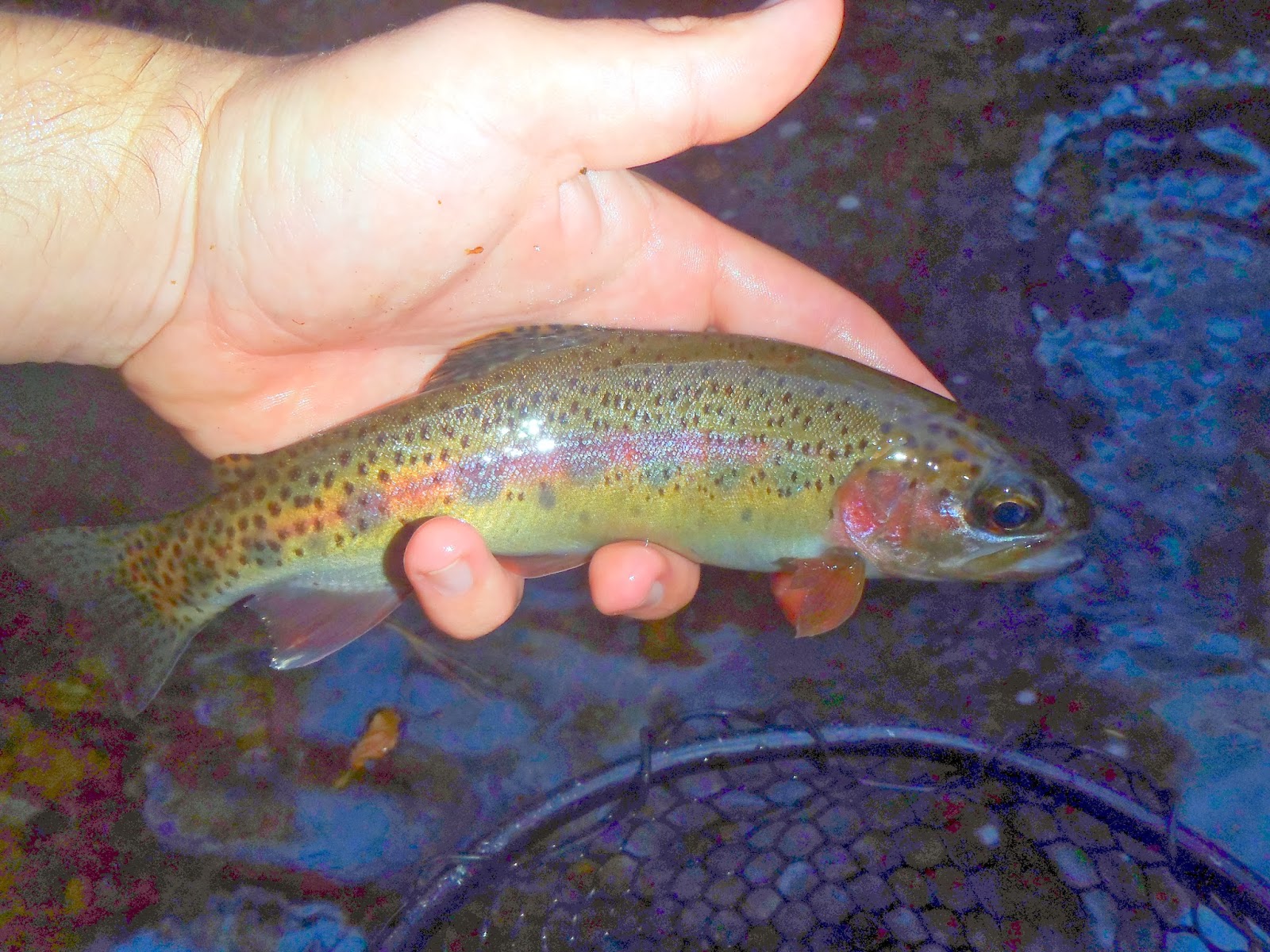
There were not many bugs present on the water but I did spot some blue winged olive mayflies and a couple of stray October caddis still fluttering around.  Although I nymph fished most of the time, I did pluck a couple of fish out of the tailouts on a size 20 parachute BWO, including this nice brown trout. When I fished nymphs, I mainly used a size 14 hares ear with a flashy pink collar or a size 16 WD-40. I fished a ton of water for the 21 fish I touched but it was really fun considering the low water conditions and got off the water about 3:30.  I wish I could say I was as successful deer hunting the last couple hours as I was during my fishing jaunt.

Signed-
Still Wishing for Venison.

Wednesday, October 16, 2013

Nymphing Hints From the Master

Our resident trout bum Landon Williams put together this helpful primer on different nymph fishing techniques that will work very well here in north Georgia.  Give them a try!


Short Line vs. Long Line Nymphing

The Proof's In The Pudding
Fly fishing with nymphs is, by and large, the most consistent way for fly fisherman to catch trout.  The majority of a trout’s feeding occurs along the bottom of a creek or river. However, nymphing methods vary far and wide across the globe.  Here in the United States, it's popular for many folks to want to nymph fish with an indicator rig using split shot, which if done correctly creates a “hinge” effect, similar to how a door operates, that gives a visual indication of when you should set the hook.   However, this system can create some problems and there is sometimes a “time lag” in how long it takes for your strike indicator to register a strike depending on factors such as how much weight you have on the line and how long your leader is.  Many times while using a strike indicator, there will be no visual that a strike has occurred, even if a fish grabs your fly.  Fishing with a strike indicator is a very practical way of fishing but you may want to consider learning new techniques that can possibly improve your catch rates and productivity out on the water.

Short-lining on the Chattahoochee
One such method goes by the technical name of “short-line” nymphing by many folks overseas or “high-sticking” here in the United States.   When fishing this method you are taking the traditional strike indicator out of equation entirely.  Instead, you are keeping in contact with your flies the entire time that you are fishing through a drift and leaving little to no slack in your fly line or leader down to your flies.  While using this setup, it is best to keep a fairly short tippet from the end of your leader. Shorter leaders 7-10 foot in length terminating in a 4x-5x tippet are great for this setup.  By now you may be wondering how you are going to get your flies down to the bottom.  The easiest way to jump right into this setup is to keep using just enough split shot to be periodically ticking the bottom.  You just keep a tight line down to your split shot and feel for larger than normal ticks or see and feel pauses in the drift, which are the usual indications that you should set the hook.  However, fishing a tight line system with split shot still can create a problem through the hinge effect that introduces slack into the line.  To counter this use flies with weight built into them in the form of weighted tungsten beads or lead wire under the dressed fly.  Weighted flies are not the end all of slack in the system, but definitely can help you take some out of it out if you fish them correctly.  Ultimately short line methods can be used with any fly rod/reel combination and are especially effective on our tighter and faster streams here in the mountains where you can usually fish very close to your quarry. 


Dukes Creek with a 30' Leader
Using a Bright Red "Sighter"
For most situations and places here in the southeast, short line techniques are perfectly adequate. However there is one other technique which, if done well, can give you more types of water to effectively fish and can ultimately improve your success.  The types of water that I’m talking about are those that most would consider least productive, slow glassy pools and long sections of shallow water where fish are often very skittish.  In my and many others opinions, long line nymphing may be the most productive way to fish. When fishing on a long line, you may have little if any fly line out, which will require you to fish a very long leader of gradually tapered monofilament.  I find it easiest to have a 20 foot section of 15-20 lb. test monofilament and taper the leader down in increments of one foot at a time with lighter test monofilament.  Mess around with varying lengths of monofilament to figure out what works best with your rod setup and where you fish. Eventually, you must taper the leader down to your tippet, which may frequently be 6X or even 7X depending upon how spooky fish may be. A natural drag free drift is essential; however you want to keep just the slightest bit of slack in the line to help you detect strikes by watching and feeling for pauses, jumps, or other abnormal behavior in your leader. A brighter section of colored monofilament, or “sighter,” built into your leader definitely helps you in your strike detection and attention to the drift. Generally, you want the flies you fish to be size 14 or smaller, slender in profile, and just heavy enough to slowly sink to the bottom. Many who fish this way prefer flexible 10-11 ft., 2-4 weight rods like Grey’s Streamflex or Sage’s ESN.  


No matter which way you fish, being more well-rounded definitely improves your chances of success on the water. Relying on one style of fishing consistently will eventually lead you to a day where it just isn’t happening and your productivity will show for it. Try these two techniques. Once mastered, they will really up your catch rate!

See you on the creek!
Landon